
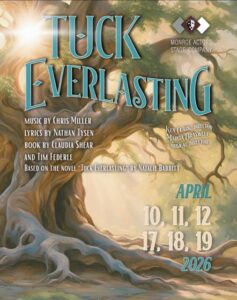
directed by Ken Clark
n turn-of-the-century Treegap, New Hampshire, 11-year-old Winnie Foster longs for freedom beyond her strict home. When she meets the mysterious, ageless Tuck family—who once drank from a secret spring—Winnie is drawn into their world and hunted by a carnival huckster who wants to exploit the spring. Over one extraordinary week she learns about love, loss, and the “wheel” of life, and must choose between eternal youth and a mortal life fully lived. The show blends folk-inflected Broadway tunes with a wordless ballet that traces Winnie’s life to its natural end. At its heart, Tuck Everlasting is a story about love, loss, and the beauty of living life fully.
Characters
Winnie Foster — Stated character age is 11; soprano A3–E5. A bright, restless only child constrained by grief and overprotection, Winnie bolts for adventure and finds moral courage when the Tucks’ secret is threatened; needs honest acting, comic timing, and stamina to anchor the show.
Jesse Tuck — Stated character age is 17; tenor F3–C5. Eternal seventeen—mercurial, charming, and a little lonely—Jesse coaxes Winnie toward possibility and tempts her with the spring’s promise; requires youthful tenor with secure mix for “Top of the World/Seventeen.”
Miles Tuck — To play 21–25; baritone/tenor F3–C5. The older brother, grounded and carrying real heartbreak; his solo “Time” demands warm lyricism and introspection; strong scene partner who shows the cost of immortality.
Angus Tuck — To play 40s–50s; tenor E3–B4. The philosophical father who teaches Winnie about the “wheel” and why life’s seasons matter; generous presence with legit/mix for “The Wheel” and tender scenes opposite Winnie and Mae.
Mae Tuck — To play 40s–50s; mezzo-soprano A3–E5. The warm, practical matriarch whose fierce love protects both family and Winnie; comfortable, maternal presence with lyric mezzo for “My Most Beautiful Day.”
Man in the Yellow Suit — To play 50s–60s; tenor G3–B4. A silky showman/carnival barker who will do anything to bottle and sell eternity; needs style, bite, and patter agility for “Everything’s Golden.”
Constable Joe — To play 40s–60s; tenor F3–B4. Treegap’s well-meaning lawman—folksy, affable, and easily dazzled; comic timing for his duet and scenes with Hugo.
Hugo — To play mid-teens–20; tenor G3–C5. An eager deputy in training who crushes on Winnie and idolizes Joe; energetic mover with bright mix for “Hugo’s First Case.”
Betsy Foster (Mother) — To play 30s; mezzo-soprano A3–E5. Newly widowed and rigid from fear, she clamps down to keep Winnie “safe”; must balance comic fussiness with genuine love and anxious vulnerability.
Nana (Grandmother) — To play 50s–60s; alto A3–C♯5. Proper, wry, and more indulgent than Mother; provides homespun humor and warmth, plus a touch of New England superstition.
Ensemble Roles – the cast requires a strong ensemble of Fairgoers and Townsfolk of all ages. Strong movers preferred.